
For bloggers, small businesses, and website owners in the U.S., the threat of copyright trolling is a persistent and costly reality. Mass plaintiffs and photo trolls are constantly refining their tactics to extract settlements, and one of their most potent – and often overlooked – tools is not a recent innovation at all. It’s the Internet Archive’s Wayback Machine.
This post will dissect how this digital library is weaponized by trolls, based on established legal use, and provide a crucial defensive measure: a step-by-step guide to removing your site from its archives.
The Legal Precedent – How Trolls Use the Wayback Machine as a Weapon
A review of legal practice reveals that archived web pages are not just curiosities; they are admissible evidence in U.S. courts when properly authenticated. This legal standing is what gives trolls their leverage. They aren’t just making empty threats; they are building cases on a foundation courts recognize.
Key points from legal analysis confirm the danger [5]:
- Admissibility is Established: Multiple federal circuit courts have ruled that screenshots and data from the Wayback Machine are admissible. Proper authentication often involves testimony about how the Archive works or a witness comparison to known authentic materials (United States v. Bansal, United States v. Gasperini).
- Judicial Notice is Common: Courts “routinely take judicial notice… of the Internet Archive’s Wayback Machine as reliable evidence of how a particular website appeared on a particular date” (Munn v. Hotchkiss School). This means a judge can accept it as a fact without extensive preliminary evidence.
- A Tool for Establishing “Public Disclosure” and Historical Fact: The Wayback Machine has been used successfully in litigation to prove when information was publicly available, to establish prior art in patent cases, and to show the historical state of regulations or product labels.
- Direct Use in IP and Consumer Litigation: Cases show the Archive used in trademark disputes (Medscript Pharmacy v. D&D Pharma), false advertising claims (Colella v. Atkins Nutritionals), and generic drug patent litigation (Jazz Pharmaceuticals v. Roxane Laboratories). This legal landscape is exactly what copyright trolls exploit.
The Troll’s Playbook: A mass plaintiff will:
- Locate an image on your website that was used without a license, perhaps years ago.
- Use the Wayback Machine to find an archived snapshot of your site from that era, providing “irrefutable proof” of the infringement’s duration.
- Cite this archived link in a demand letter or lawsuit, calculating damages based on the long archival history, even if the image was removed last week.
The content may be gone from your live site, but the archive remembers everything. It provides the “when” and “how long” that trolls use to inflate settlement demands.
Proactive Defense – Removing Your Site from the Wayback Machine
Denying trolls easy access to your site’s history is a critical step in “troll-proofing” your online presence. Removing your site from the Wayback Machine is a straightforward process.
Step 1: The Initial Request
Send an email from an address listed on your website’s domain (e.g., admin@yourdomain.com, hello@yourdomain.com – typically found in the site footer or contact page).
- To: info@archive.org
- Subject: Request for Website Removal from Wayback Machine
- Body:
Dear Wayback Machine Support Team,
I am writing to formally request the removal of my website, https://yourwebsite.com, from the Wayback Machine archives. As the owner, I do not wish for my site to be archived by your service. I also request the removal of all previously archived versions.
Thank you for your understanding and assistance.
Best regards,
[Your Name]
Often, this is sufficient, and your site may be removed within a few days.
Step 2: The Formal Process (If Required)
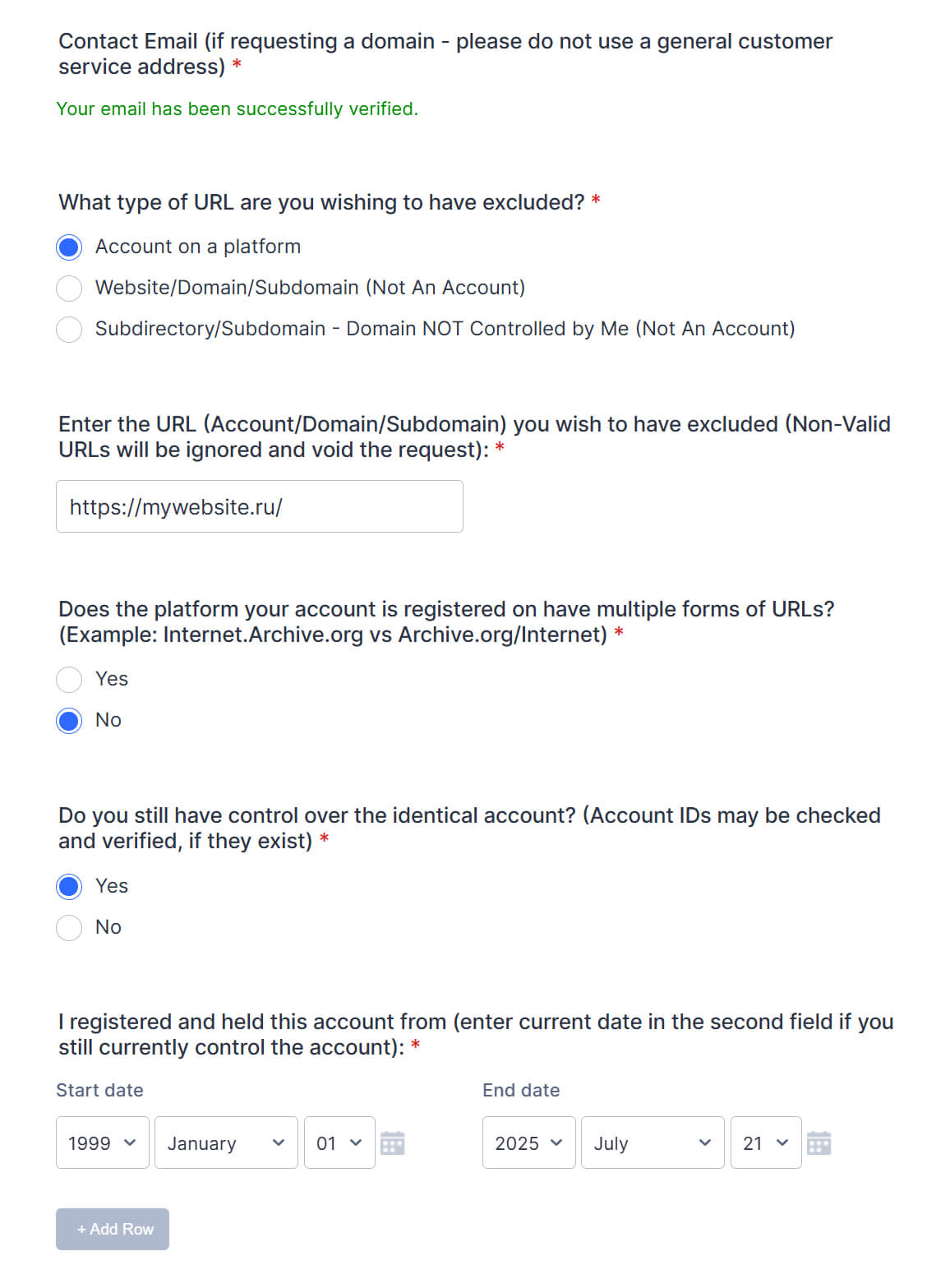
If the initial request triggers a follow-up, you will receive an email from support@archivesupport.zendesk.com with a link to an official removal form (e.g., https://form.jotform.com/233465872728064).
- Enter the email associated with your website domain.
- You will instantly receive a confirmation code at that email. Enter it.
- On the final form, provide:
- Website URL: https://yourwebsite.com
- Date Range: Select “All dates” or specify from your site’s launch to the current date.
Step 3: Confirmation and Completion
Within approximately two days, you should receive a confirmation that your URL has been submitted for exclusion. Archived copies typically disappear within 24 hours after that.
Conclusion: A Necessary Layer of Hygiene
Removing your site from the Wayback Machine is not paranoia; it’s digital hygiene in the age of legal shakedowns. While determined trolls may attempt to document infringement through other means, you have now removed a primary, court-validated source of historical “evidence” that makes their business model efficient and profitable. You have directly increased their cost of doing business.
Do not make a troll’s job easier. Take this proactive step today. Send the email, fill out the form if needed, and eliminate one of their favorite tools from your defensive equation.
Disclaimer: This post is for informational purposes and does not constitute legal advice. For specific legal concerns regarding copyright infringement or litigation, consult with a qualified attorney.